
When it comes to the health of children's teeth, timing plays an important role in the success of treatment. Some jaw and dental problems, if not diagnosed at an appropriate age, require more complex and longer treatment later. Two-stage orthodontics or two-phase orthodontics is a method that corrects problems in the best possible time by taking advantage of the child's natural growth.
This method is not only for children who have crooked teeth, but it is also used to correct jaw disharmony, bad oral habits and prevent future problems. In this article, we explain what two-stage orthodontics is, how it is performed, and which children need it. If you want to make an informed decision for the health of your child's smile, stay with us until the end.
What is two-phase orthodontics?
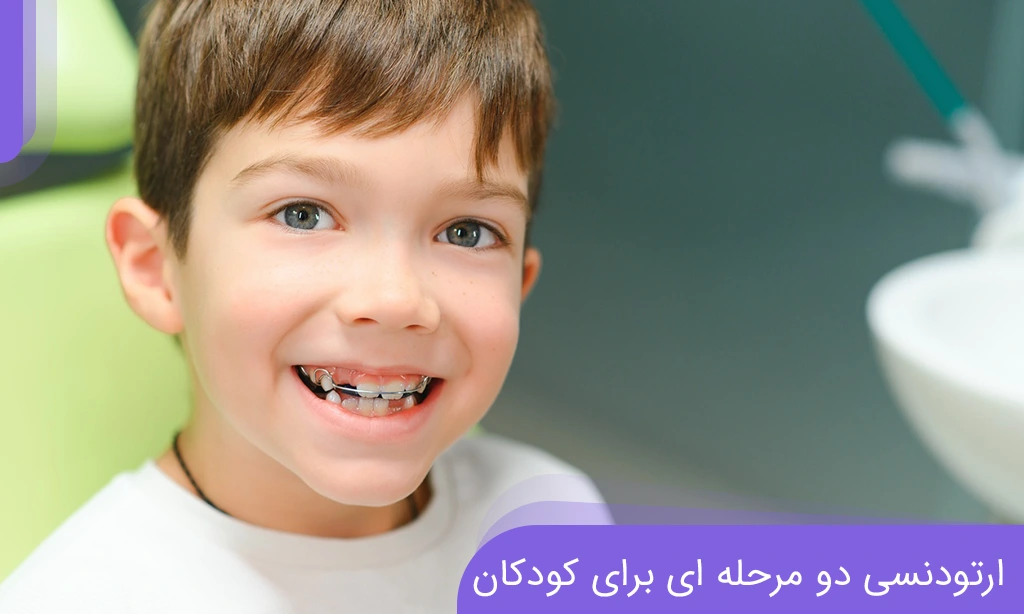
Two-stage orthodontics is a specialized treatment for children, which is performed in two different time periods based on the child's natural growth process. The first stage, which aims to correct jaw problems, guide bone growth and prepare the mouth for the proper eruption of permanent teeth, begins when there are still some baby teeth in the mouth.
After a period of rest, the second stage is done after the eruption of permanent teeth. At this stage, the teeth are completely arranged with fixed orthodontics and the result of the treatment is stabilized.
This method is used when the child's jaw problem is so serious that if the treatment is postponed until an older age, its correction will be much more difficult and long. In some cases, it cannot be treated even with ordinary orthodontics, and more complex treatments such as jaw surgery may be needed in the future.

As a specialized orthodontic clinic, during our 25 years of operation, we have heard many repeated questions from patients about orthodontics. Many people mistakenly think that orthodontics is not effective only in old age or that the treatment costs are astronomical. On the dental orthodontics page, we have created a complete guide to patient questions about dental wiring, along with real patient treatment examples. For more information, visit Dental Orthodontics page.
In what circumstances does a child need two-stage orthodontics?
Two-stage orthodontics is recommended when the growth pattern of the child's jaw is out of the normal state or when the orthodontic specialist determines that it will be difficult and complicated to correct jaw and dental abnormalities in old age.
In such cases, with early intervention and preventive orthodontics, the growth path of the jaw can be corrected and the aggravation of abnormalities can be prevented in order to create suitable conditions for the growth of permanent teeth.
The most important conditions in which a child needs two-phase orthodontics are:
- anterior or posterior crossbite that causes deviation of the jaw or disturbance in biting and chewing
- Severe lack of space for permanent teeth to grow
- Overlapping or locking of teeth that does not correct naturally
- Harmful oral habits such as finger sucking, pressing the tongue against the teeth or mouth breathing
- jaw deviation or facial asymmetry during growth
- severe protrusion of front teeth that increases the possibility of damage or fracture
- Premature or late loss of milk teeth that disrupts the growth pattern
- jaw disorders that cause the child's inability to open and close the jaw

two-stage orthodontic procedures for children
Two-phase orthodontics is a scheduled treatment program that is carried out in a targeted manner and according to the child's growth. This process includes two main phases and a rest period between them, each of which has a specific role in improving the growth of the jaw and arranging the teeth.
The first stage (phase 1)
The first phase of two-stage orthodontics usually begins between the ages of 6 and 9. That is, when the child still has some milk teeth and the jaws are actively growing. At this stage of children's orthodontics the focus is on correcting jaw abnormalities, controlling oral habits and preventing the aggravation of future problems. The length of treatment in this phase varies depending on the type of child's problem and usually lasts 9 months to 1 year.
In the video below, you can see the experience of young patients from placing removable orthodontic plates at Dr. Khadavi, an orthodontic specialist in Tehran:
Treatment goals in the first stage of two-phase orthodontics
- Correction of jaw structural problems
- control of upper or lower jaw growth pattern
- Creating a suitable space for the regular growth of permanent teeth
- Correcting oral habits such as finger sucking or mouth breathing
- reducing the possibility of needing more complex treatments in the future
- Preventing aggravation of jaw deviation or asymmetry
- Reducing the risk of damage to the front teeth in cases of severe protrusion
devices used in the first stage of treatment
The tool used in the first stage of two-phase orthodontics depends on the type of jaw and dental deformity of the child and the diagnosis and discretion of the orthodontist. The following orthodontic tools are the most used for children's orthodontics at this stage:
- Palate expander or palatal expander to enlarge the jaw arch and increase the space for the teeth
- Tooth retaining space in order to maintain the empty space of the missing tooth and prevent crooked teeth
- Orthodontic face mask to correct the growth pattern and position of the jaws
- Functional orthodontics to correct mild problems and guide growth
- Orthodontic retainer to control the growth of the jaw and correct its anterior or posterior position
- Haber to correct habits such as finger sucking or tongue thrusting
- Fixed brace installation on some teeth

rest phase in two-stage orthodontics
The resting phase is an interval between the first and second stages of treatment, during which the child does not receive any active device and only undergoes periodic examinations. The purpose of this course is to allow the permanent teeth to grow naturally and to evaluate the result of the initial interventions.
During this interval, the orthodontist examines the growth process of the jaw, teeth growth and the stability of the results of the first stage so that the second stage of treatment can be started at the right time. This course usually lasts for several years and is very important in the final success of two-phase orthodontics.
Second stage (phase 2)
After the resting phase and when all the permanent teeth have appeared in the jaw arch, the second phase of two-phase orthodontics begins. This period coincides with early adolescence, that is, between the ages of 11 and 13.
At this stage, the main focus is on the accurate arrangement of the teeth, the final correction of the relationships between the jaws, and the stabilization of the treatment results. In the second phase, fixed orthodontic metal or ceramic brackets and in some cases transparent aligners are used to guide the teeth to the correct position.
At this stage, the orthodontist corrects the position of the teeth, closes the extra spaces, corrects the rotations and adjusts the bite accurately so that the child's smile is in the best condition both in terms of function and beauty.

Duration of treatment in phase 2
The length of treatment in the second stage depends on the severity of the initial problem, the patient's cooperation and the type of orthodontic device, and it takes about 12 to 24 months. During this period, the patient should visit his orthodontist regularly to adjust the brackets or check the clear aligners so that the treatment process proceeds accurately and the final result is stable and reliable.
before and after orthodontics of two stages of Dr. Khdywy's patients
Getting the best result from two-stage orthodontics is largely dependent on the orthodontist's experience in diagnosing the problem and developing a treatment plan. Dr. Khadivi, orthodontist in Tehran, with 25 years of experience in children's orthodontics, guides you for the best time to start treating your child. With a detailed treatment plan, the best result will be achieved to maintain the beauty of your child's teeth.
In the video below, you can see the before and after form of the teeth of one of Dr. Khedevi's patients who underwent two-phase orthodontic treatment:
In the video below, one of the 14-year-old patients talks about his treatment experience at Dr. Khedevi's orthodontic clinic:
You can also book a free orthodontic consultation appointment for your child and teenager, and take action now for timely treatment and healthy teeth.
How much does two-stage orthodontics cost?
The cost of two-stage orthodontics is not the same for all children and is determined based on the type of jaw deformity, the duration of each stage and the type of devices used for treatment. Also, the age of the child, the level of cooperation and the number of required sessions can change the cost.
Do you want to start orthodontics but do not know the exact cost of treatment? We have provided you with a complete list of orthodontic prices along with an online orthodontic cost calculator in Tehran so that you can have a better estimate of the price of 1404 orthodontics. Just visit the page cost of orthodontics right now.

two-phase orthodontic consultation for children with Dr. Khdywy
two-stage orthodontics is an effective method for correcting children's jaw and dental abnormalities, which, with careful planning and taking advantage of natural growth, creates stable results and brings a healthy smile to the child. The skill and experience of the orthodontist plays a very important role in achieving the desired result.
Dr. Khedavi, with 25 years of experience and membership in the Association of Orthodontists of America, Europe and Iran, is one of the best children's orthodontic specialists, and by carefully examining the growth of the jaw and teeth, he determines the best time and method of treatment according to your child's condition.
Parents can start their child's two-phase orthodontic treatment with confidence by visiting one of their three branches in Mirdamad, Tehranpars or Nawab. Apply now to reserve your child's free orthodontic consultation appointment.